
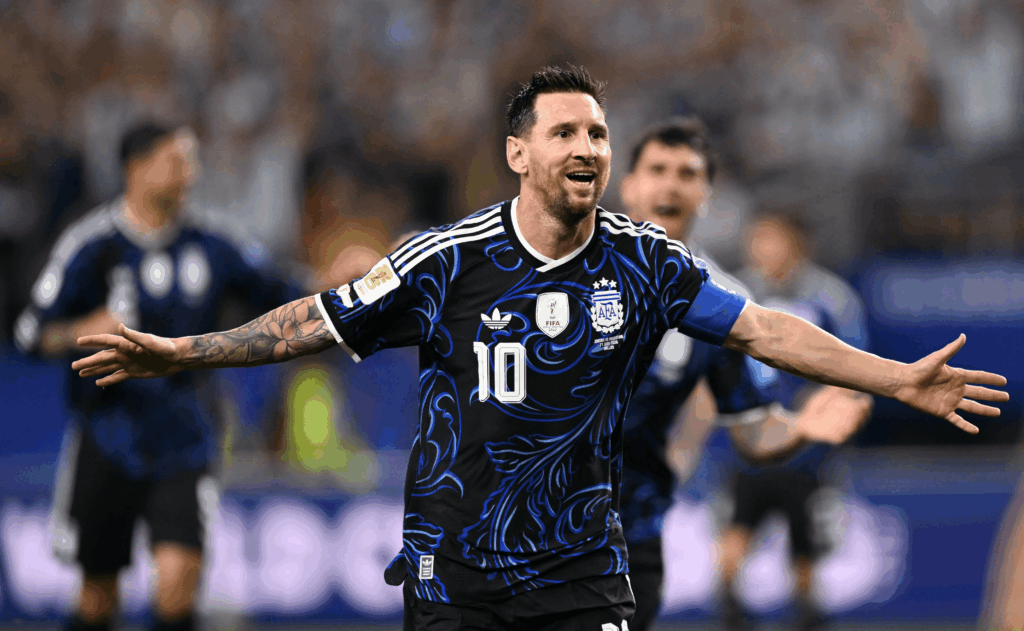
England will face Argentina in the semifinals of the 2026 World Cup, bringing one of international football’s most intense rivalries back to the competitive stage after a 24 year absence.
The Three Lions secured their place in the last four by recovering from an early setback against Norway. Jude Bellingham scored both goals as England completed the comeback and reached a World Cup semifinal for only the fourth time in their history.
Argentina will now stand between England and a place in the final. The two national teams have produced several unforgettable matches, often shaped by disputed decisions, red cards and incidents that remained part of football history long after the final whistle.
Their most recent meeting in any competition came at the 2002 World Cup, while the last match between them was England’s 3 to 2 friendly victory in 2005. Before they meet again on Wednesday night, here is a ranking of five of the most controversial moments in this historic rivalry.
5. Police remove Antonio Rattín after his dismissal
England and Argentina met at Wembley in the quarterfinals of the 1966 World Cup, a tournament eventually won by the hosts. The match is remembered not only for England’s victory but also for a dismissal that helped change the way referees communicated disciplinary decisions.
Argentina captain Antonio Rattín was sent off for dissent by German referee Rudolf Kreitlein. However, Rattín claimed he did not understand why he had been dismissed and requested an interpreter.
The Argentine refused to leave the field and remained on the pitch for around 10 minutes. Eventually, police officers were called to escort him away, creating one of the most unusual scenes in World Cup history.
Yellow and red cards were not yet used at the time. The confusion surrounding Rattín’s dismissal became one of the main reasons football authorities introduced a universal card system that players, referees and spectators could understand regardless of language.
Rattín died at the age of 89 on July 11, 2026. Argentina’s players wore black armbands in his memory during their victory over Switzerland.
4. Daniel Bertoni knocks out Trevor Cherry’s teeth
Another heated incident occurred during a friendly between the teams in 1977. The match was played at La Bombonera, one of Argentina’s most famous and intimidating stadiums.
With seven minutes remaining, England defender Trevor Cherry challenged Daniel Bertoni from behind. It was a forceful tackle and the Argentine forward reacted immediately.
Bertoni got back to his feet and punched Cherry directly in the mouth. The blow knocked out two of the England player’s front teeth.
The referee sent off both men. Bertoni was dismissed for throwing the punch, while Cherry also received a red card for the original challenge.
The incident also gave Cherry an unwanted place in England’s record books. He became the first player representing the national team to be sent off in an international friendly.
Although this confrontation is less famous than later clashes between the countries, it remains one of the most violent episodes in their shared history.
3. Owen wins a disputed penalty against Pochettino
England’s last competitive meeting with Argentina took place during the group stage of the 2002 World Cup. The match ended in a 1 to 0 victory for England, but the decisive penalty remained a source of argument long afterwards.
Late in the first half, Michael Owen went down inside the area after a challenge from Mauricio Pochettino. Italian referee Pierluigi Collina decided that the Argentine defender had committed a foul and awarded England a penalty.
David Beckham converted the spot kick, scoring the only goal of the match. The result helped England advance to the knockout rounds, while Argentina finished third in the group and suffered an early elimination.
Pochettino always disputed the decision. Speaking in 2016, while working as Tottenham manager, he accused Owen of exaggerating the contact.
The former Argentina defender insisted that he had not touched the striker and compared Owen’s fall to a swimmer diving into a pool. His comments showed that even 14 years later, he still considered the penalty unfair.
For Beckham, the goal carried additional meaning. It offered a measure of revenge following the criticism he had received after being sent off against Argentina four years earlier.
2. Beckham sees red after reacting to Simeone
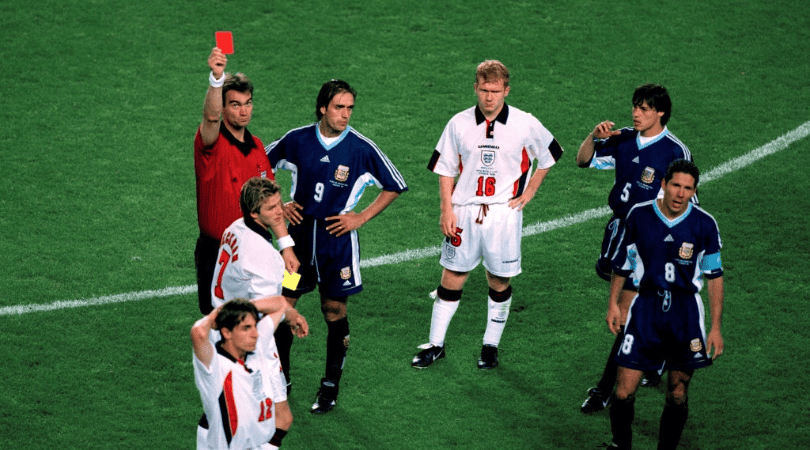
One of the rivalry’s most famous matches came in the round of 16 at the 1998 World Cup. England and Argentina produced a dramatic contest that included four goals, a red card and another painful penalty shootout for the Three Lions.
The score was 2 to 2 at halftime. Gabriel Batistuta opened the scoring from the penalty spot before Alan Shearer equalised with another penalty. Michael Owen then scored one of the most celebrated goals of his career, but Javier Zanetti brought Argentina level with a clever free kick routine.
The major controversy arrived two minutes after the interval. Diego Simeone fouled Beckham from behind, leaving the England midfielder on the ground.
As Simeone moved away, Beckham kicked out with his leg and made contact with the Argentine. The reaction was not particularly forceful, but Simeone fell to the ground and referee Kim Milton Nielsen showed Beckham a red card.
England played the rest of the match with 10 men but still managed to force extra time and penalties. Sol Campbell also had a goal disallowed during the second half after the referee ruled that Alan Shearer had fouled goalkeeper Carlos Roa.
Argentina eventually won the shootout after Paul Ince and David Batty failed to score. England’s poor penalty record continued until the national team finally defeated Colombia in a shootout at the 2018 World Cup.
Beckham became the main target of criticism following the defeat. Newspapers and supporters blamed him for the elimination, and the midfielder faced months of hostility after returning to English football.
1. Maradona scores with the Hand of God
Diego Maradona’s Hand of God is not only the most controversial incident between England and Argentina. It is also one of the most debated moments in sporting history.
The teams met in the quarterfinals of the 1986 World Cup in Mexico. Six minutes into the second half, with the score still goalless, Maradona attempted to reach a loose ball inside the England penalty area.
Goalkeeper Peter Shilton came off his line and appeared likely to collect it. Maradona jumped beside him but used his left hand to knock the ball over the goalkeeper and into the empty net.
England’s players immediately protested, but Tunisian referee Ali Bin Nasser allowed the goal. He later maintained that he had not seen the handball and relied on his assistant, who also failed to signal an offence.
Maradona ran away celebrating while several England defenders surrounded the officials. The goal quickly became known as the Hand of God after the Argentine described it as being scored partly by his own head and partly by divine intervention.
Only four minutes later, Maradona produced a completely different type of goal. He collected the ball inside his own half, moved past several England players and finished beyond Shilton.
That second effort became known as the Goal of the Century and is widely considered one of the finest goals ever scored at a World Cup.
Gary Lineker later pulled one goal back for England, but Argentina held on for a 2 to 1 victory. One week later, Maradona lifted the World Cup after his team defeated West Germany in the final.
The match created two lasting images of the same player. One showed Maradona using deception to gain an advantage. The other demonstrated his extraordinary skill. Together, those goals ensured that the 1986 quarterfinal would remain central to the England and Argentina rivalry for generations.
The teams now prepare to meet again with another World Cup final within reach. Their history suggests that the semifinal may produce far more than goals alone.