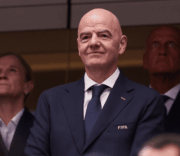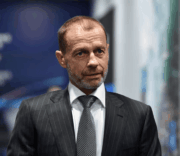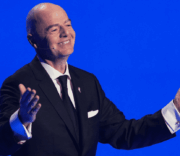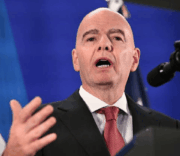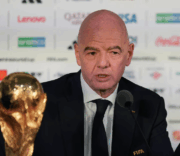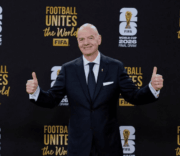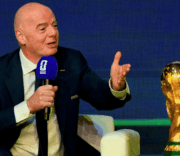

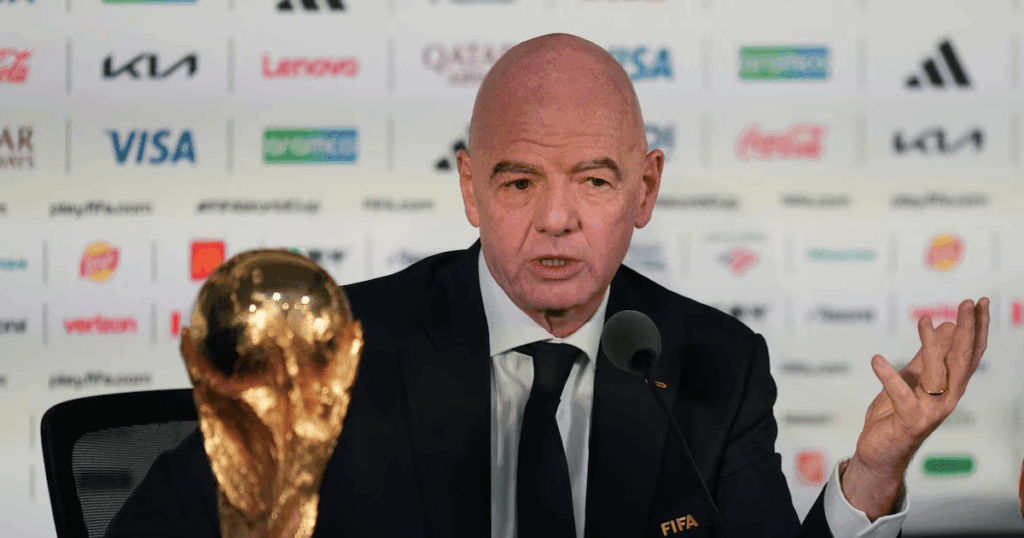
Prime Minister Andy Burnham has described Gianni Infantino as the wrong person to remain in charge of Fifa after criticism of the president’s commercial proposals intensified across world football.
Burnham’s comments followed the resignation of one of Infantino’s most senior advisers and a public rejection of the plan by a third continental confederation.
The dispute centres on Fifa’s intention to establish a commercial subsidiary that would control its leading competitions, including the World Cup, while allowing private investors to purchase minority shares in the new company.
Burnham had already criticised the proposal when it first became public. Speaking to reporters on Friday, he said the plan should never have reached such an advanced stage.
He argued that the decision to present the idea showed Infantino was not suitable to continue leading world football’s governing body.
His intervention came only hours after the Asian Football Confederation announced that it supported the concerns raised by football authorities in Europe and North America, Central America and the Caribbean.
Asian confederation joins opposition to Infantino’s proposal
The AFC said Infantino’s project was unlikely to secure the broad agreement and unity needed for such a major change to Fifa’s commercial structure.
In its statement, the confederation stressed that the World Cup remains the leading competition in international football because every region can participate and the strongest national teams are involved.
The AFC warned that any measure capable of weakening the global and inclusive nature of the tournament should be reconsidered before further steps are taken.
Soon after the statement was published, Carlos Cordeiro resigned from his position as Infantino’s senior adviser for global strategy and governance.
Cordeiro called the proposal a poor agreement for football and said it could place the future of the sport at risk for the sake of short term commercial gains.
The AFC’s opposition has made it increasingly difficult for Infantino to secure enough support if the plan is presented to Fifa members for a formal vote.
Infantino had suggested that a simple majority would be required. Fifa has 211 member associations, meaning at least 106 would have to approve the proposal.
Uefa controls 55 votes, Concacaf has 35 and the AFC represents another 46 associations. Together, those three confederations account for 136 countries.
If every national association followed the position of its regional governing body, Infantino would fall well short of the support needed to proceed.
However, individual associations would still be free to vote differently, particularly in regions where Fifa funding remains an important source of money for stadiums, training facilities and grassroots programmes.
AFC criticises Fifa’s consultation process
The AFC’s objections went beyond the question of private investment.
It accused Fifa of deciding the likely direction of another major initiative before properly consulting the organisations and associations that would be affected by it.
According to the confederation, the absence of meaningful discussions with member associations exposed serious problems in Fifa’s decision making and consultation procedures.
The AFC said continental bodies, national federations and even Fifa’s own governing institutions had been left outside the process.
It specifically referred to the Fifa Council, which would normally be expected to play an important role in examining proposals of such importance.
The confederation said the World Cup and football itself belong to the entire international football community rather than to one president, department or group of investors.
It argued that decisions about the sport’s future must be taken collectively through institutions that represent all confederations and member associations.
The AFC has now called for an urgent review of Fifa’s governance framework.
It wants future proposals with global consequences to pass through proper consultation, detailed engagement and appropriate supervision from Fifa’s statutory bodies before they are submitted for approval.
Unlike Uefa, the Asian confederation has not threatened to withdraw from Fifa tournaments. Its member associations are also not formally required to oppose the project if a vote takes place.
Cordeiro resigns after almost five years as senior adviser
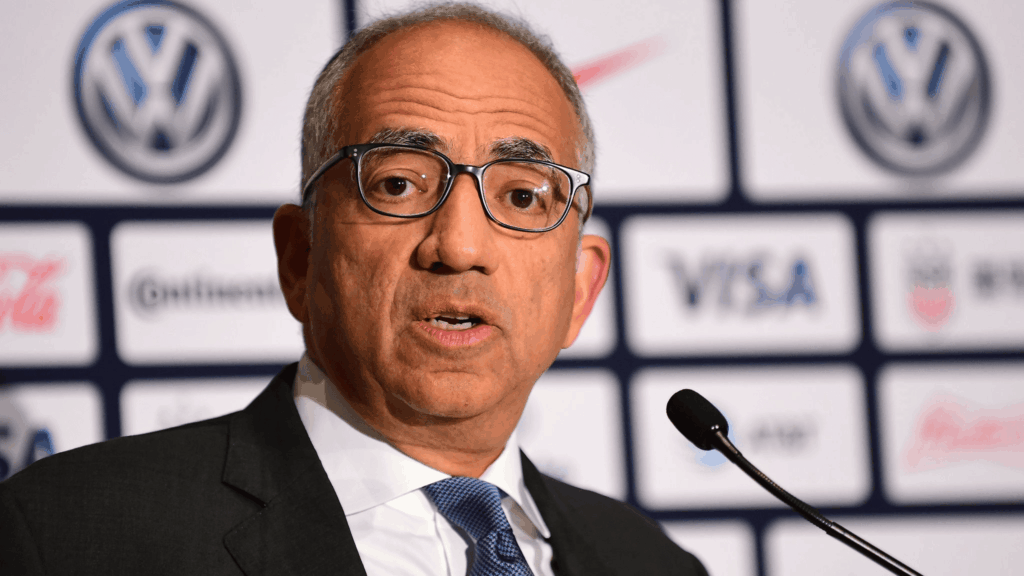
Carlos Cordeiro had served as a senior Fifa adviser for four years and 11 months before stepping down.
He was appointed in September 2021 and represented Fifa on the White House taskforce established for the 2026 World Cup.
Before entering football administration, Cordeiro worked as an investment banker at Goldman Sachs.
He is the first senior official inside Fifa to resign directly because of the proposed commercial restructuring.
In a detailed statement, Cordeiro said he opposed the plan without reservation.
He rejected the argument that Fifa needed outside investors to generate more value from its competitions and commercial rights.
Cordeiro wrote that the proposal had become a defining issue for the future of the organisation.
He said Fifa’s duty was not to secure the highest possible financial return regardless of the consequences.
Instead, its responsibility should be to protect football, strengthen its institutions and preserve the sport for the generations that follow.
Cordeiro argued that when commercial goals clash with the wider interests of the game, football must take priority.
He also made clear that he had not participated in developing the investment plan.
The former adviser said some of the most basic questions about the proposal had still not been answered.
He asked why this particular deal had been chosen, why it was being introduced now, what systems of supervision would apply and which organisations or individuals stood to benefit.
Cordeiro said member associations were being expected to make a decision with enormous long term consequences in less than 50 days.
In his view, that timetable did not offer enough time for detailed analysis or responsible debate.
He concluded that such an approach was not an acceptable way to decide the future direction of the world’s most popular sport.
Fifa wants private investors in a new commercial company
Fifa and Infantino intend to create a subsidiary responsible for operating and commercialising the organisation’s main competitions.
The company would manage events including the men’s and women’s World Cups, while outside investors would be invited to purchase minority shares without receiving full control.
The proposed business would be called Fifa Forward Enterprise, also referred to as FFE.
Fifa has said third parties would only be able to make non controlling investments in the subsidiary.
A 25 page document prepared by investment bank JP Morgan outlines the financial expectations behind the project.
The document suggests that Fifa tournaments could be expanded further and that every member association might receive about 24 million euros during the financial cycle covering 2035 to 2039.
It also refers to new commercial activities and plans to recruit leading executives through pay packages linked to performance and incentives.
The World Cup is presented as the most watched sporting event in the world.
At the same time, the document argues that Fifa has not generated as much commercial value from the competition as it could.
The women’s game is not mentioned in the document, despite the proposed subsidiary being expected to control Fifa’s main tournaments.
If the project receives approval, Thrive Eternal is expected to lead the group of investors seeking to purchase shares in FFE.
Thrive is an American venture capital company founded by Joshua Kushner, the brother of Jared Kushner, who is the son in law of United States President Donald Trump.
The connection has contributed to concerns about political influence, personal relationships and the possibility that private financial interests could gain access to Fifa’s most valuable assets.
Uefa and Concacaf reject the plan
On Thursday, Uefa members voted to boycott future World Cups if Fifa continued with the proposal.
Several hours later, Concacaf issued its own statement rejecting Infantino’s plans.
Concacaf oversees football in North America, Central America and the Caribbean and hosted this year’s World Cup.
Fifa responded early on Friday by insisting that the project would continue.
The organisation also claimed that football was not being sold.
Fifa said the consultation process had been damaged by inaccurate reports in the media and argued that the new company would not weaken the organisation’s values or governance.
Its critics remain unconvinced.
Uefa has accused Fifa officials of using football to increase the wealth of themselves and people close to them.
Both Concacaf and the AFC have raised concerns about the lack of consultation and the limited role given to member associations before the project was announced.
Uefa said the World Cup could not be treated like a financial asset designed for investors.
It described the tournament as one of football’s most important legacies, created over many generations by national teams, players and supporters from every continent.
The European body insisted that no part of the competition should be transferred to private investors.
South American football authority Conmebol has not yet issued a public response.
The Confederation of African Football and the Oceania Football Confederation have said they will consider Fifa’s plans during meetings in August.
Financial dependence may influence smaller associations
Although several powerful confederations oppose the proposal, Infantino may still receive support from smaller national associations.
Many Uefa members benefit from wealthy domestic leagues, established stadiums and substantial broadcast agreements.
Associations in other parts of the world often depend more heavily on money distributed through Fifa development programmes.
For those federations, a plan promising larger payments may appear attractive even if questions remain about control, accountability and private ownership.
Rogers Byamukama of the Ugandan Football Federation said football was particularly expensive to operate in Africa, where reliable sources of funding were often limited.
He explained that Fifa revenue from World Cup ticket sales and sponsorship agreements had helped finance infrastructure projects in Uganda.
Fifa money had also supported grassroots programmes and football projects in schools.
From Byamukama’s perspective, any proposal capable of producing additional resources deserved consideration because the money could be distributed to federations and used to support football’s development across Africa.
He accepted that Uefa had the right to oppose the plan.
However, he also suggested that European associations did not rely on Fifa funding to the same degree as many federations elsewhere.
This difference helps explain why Infantino continues to enjoy support in parts of Africa, Asia and other developing football regions despite growing criticism from Europe.
During the first two cycles of the Fifa Forward development programme, which ran until 2022, a total of 2.8 billion dollars was made available for investment among the organisation’s 211 members.
Fifa Forward 3.0 covers the period from 2023 to 2026 and has increased available funding by 30 percent.
Fifa has provided another 5 million dollars to each member association.
Every confederation has also received 60 million dollars for projects under its own control.
These payments give many smaller associations a strong reason to maintain good relations with the Fifa leadership and to consider proposals that promise even larger distributions in future cycles.
Tournament expansion remains part of Fifa’s strategy
The investment proposal is part of a broader effort by Fifa to enlarge its competitions and increase the revenue generated from them.
The men’s World Cup has already expanded from 32 to 48 teams for the 2026 tournament.
Fifa is now looking for an independent agency to examine whether the 2030 World Cup could be expanded again to include 64 national teams.
Documents reviewed by BBC Sport show that agencies were expected to submit proposals to Fifa by 7 August.
Fifa planned to select the successful agency on 14 August.
The chosen organisation would then be expected to complete its assessment by 11 September.
A further expansion could create more matches, additional broadcasting content, higher sponsorship income and more opportunities for national associations to qualify.
It could also increase demands on players, clubs, host countries and existing international calendars.
For critics of Infantino’s investment plan, the possibility of a 64 team World Cup reinforces concerns that commercial growth is becoming more important than sporting balance.
For some smaller nations, however, expansion offers a greater chance of reaching the tournament and gaining access to the financial and sporting benefits associated with participation.
The dispute is therefore not limited to a disagreement between Infantino and Europe.
It has exposed a wider divide between wealthy football nations seeking to protect the World Cup from private capital and less affluent associations that depend on Fifa distributions to fund the game at home.